
Staying with the Trouble
Living in Communion through Climate Crucifixion

My partner and I sometimes talk about leaving.
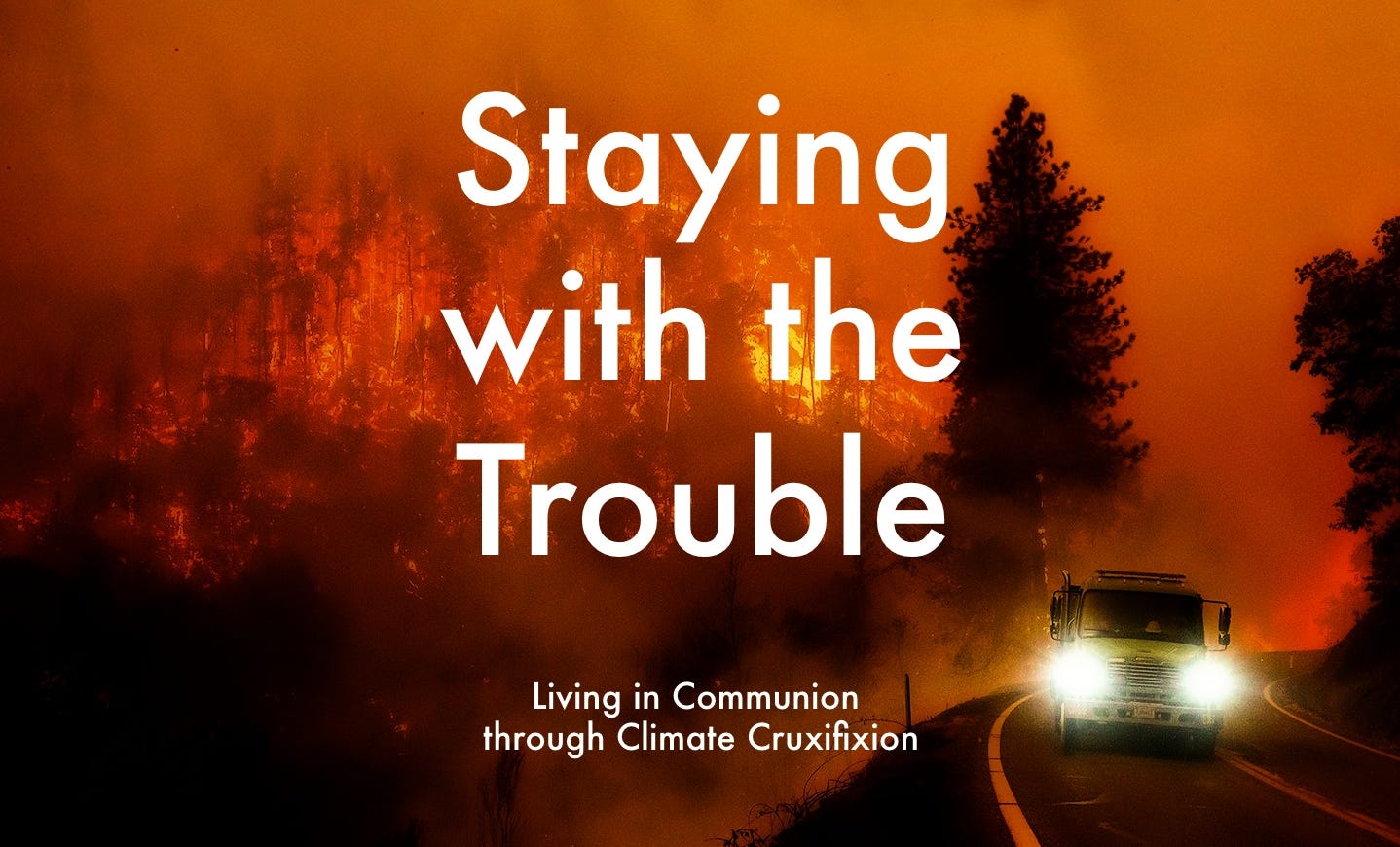
We are Northern Californians—neither of us by birth or ancestry, but we both feel a pull to this land—and it has been a difficult decade. If you can somehow manage to deal with the dehumanizing cost of living and the tech-bro tyranny reshaping so much of our infrastructure and culture, you still have the wildfires. The summer of 2018, over a year before COVID hit, we were walking around in respirator masks for weeks, the air and horizons sick with yellow-gray smoke. It almost looked like snow, the ash scattered over parked cars and sidewalks. That ash traveled a hundred miles. “Fire season,” in case you’ve never lived in a place where this is a thing, is an annual tradition: we expect wildfires to tear through forests and threaten the surrounding cities. And it’s getting worse. Sometimes we talk about leaving, my partner and I, finding a place to live that is not quite so hostile on so many fronts.
Responding to climate crisis and ongoing human-led destruction of life on our planet, environmental humanities scholar Donna Haraway writes about the practice of “staying with the trouble.” She argues that we must develop ways of living here, in troubled times, that don’t rely on imagined “edenic pasts” or “apocalyptic or salvific futures” that lead to apathy or inaction.1 Instead, we must learn “to be truly present [...] as moral critters” (that’s creatures for those of you who don’t speak the dialect) who are entangled and enmeshed in “unfinished configurations of places, times, matters, meanings.”2 We are always growing, evolving, and being made new in concert, in communion, with the beings and environments who are our co-habitants.
Haraway puts her finger on something that I’ve felt for a long time, though she says it in different terms. Survival cannot be our standard. So much of the talk and action around environmentalism today is geared towards solving or slowing climate change, prolonging the existence of our species. And hey, I don’t want to go extinct, either! But what troubles me more is what we have lost of our own nature. God created us in conjunction with, alongside and interdependent with, the more-than-human world. All of creation is horizontally connected. For humans to walk around as if we own the place, as if our wants, our comforts, our profits, and our perspectives are the only ones that matter, is for us to forsake the way we were meant to live.
Staying with the trouble, living in and with climate catastrophe (and deforestation, and urban sprawl, and the homogenization of every city on the planet…), means, for me, staying in this place I love, even though it puts me at risk. It means accepting risk, suffering, and loss, and in the words of the poet Ross Gay, “loving / what every second goes away.”3 It means living in communion with creation, all of which Christ reconciles to God—in the Incarnation, in the Crucifixion, in the Resurrection, and in the Eucharist.
Former Archbishop of Canterbury Rowan Williams writes, “If being baptized is being led to where Jesus is, then being baptized is being led towards the chaos and the neediness of a humanity that has forgotten its own destiny” (shoutout to David S. Harvey for sharing this quote).4 Williams goes on to suggest that the Christian should be “somebody who is not afraid of looking with honesty at that chaos inside [themselves], as well as being where humanity is at risk, outside.”5 As I believe that Christ came to save all of creation, and not just humanity, I would extend Williams’s descriptions of risk, chaos, and neediness to the more-than-human world, as well. We must look at the violence we are doing. We must see that the destruction of so much life on God’s earth is rooted in sin. And like any sin, it tarnishes the soul, the essence of who we are meant to be.
I was baptized in a church building with tepid tap water that a priest had prayed over. I have no regrets or critiques of this, but I can see the sacramental value of being baptized in a river or a creek. Baptism calls us, I think, to face the neediness of all of creation, to recognize that the troubles of the climate and the troubles in our hearts are twinned. To stay with that trouble, to live with it, in vulnerability and compassion, in suffering and uncontrollable hope,6 to keep the faith that God will make all things—blood and bone, skyline and clear cut, coral reef and community garden—new. (Revelation 21:5)
We’re not leaving California, at least not yet. My work right now is to try to see the suffering of the cities and the suffering of the forests, here, as bound up in the suffering of Christ on the Cross. How long did the Blessed Mother and Mary Magdalene stay at the feet of their crucified God and beloved on that hill? Until He was buried, I think.
Being Christians in troubled times calls us to stand before the Cross while simultaneously entering more fully into creative and loving relationships with the people, environments, and fellow-creatures around us—to make kin, as Haraway says.7 (“Behold your mother!” John 19:27) Let us live on this suffering and magnificent planet, God’s planet, and plant a few seeds for the Kingdom.
Donna Haraway, Staying with the Trouble, 1.
Ibid., 1.
Ross Gay, “Catalog of Unabashed Gratitude.” https://waxwingmag.org/items/91.php

Williams, Being Christian, 5.
Karl Rahner, “On the Theology of Hope.” He describes theological hope as “that act in which the uncontrollable is made present as that which sanctifies, blesses and constitutes salvation without losing its character as radically beyond our powers to control, precisely because this salvific future is hoped for but not manipulated or controlled.” Theological Investigations, Vol X, 254-255.
Haraway, Staying with the Trouble, 2.
St Maximus said:
Someone might ask, “Why would a holy man desire baptism?” Listen to the answer: Christ is baptized, not to be made holy by the water, but to make the water holy, and by his cleansing to purify the waters which he touched. For the consecration of Christ involves a more significant consecration of the water
For when the Savior is washed all water for our baptism is made clean, purified at its source for the dispensing of baptismal grace to the people of future ages. Christ is the first to be baptized, then, so that Christians will follow after him with confidence.
- The tepid water or the river water, all is of Christ!
Beautiful and courageous!